How to Hang Art at the Right Height, Light and Spacing
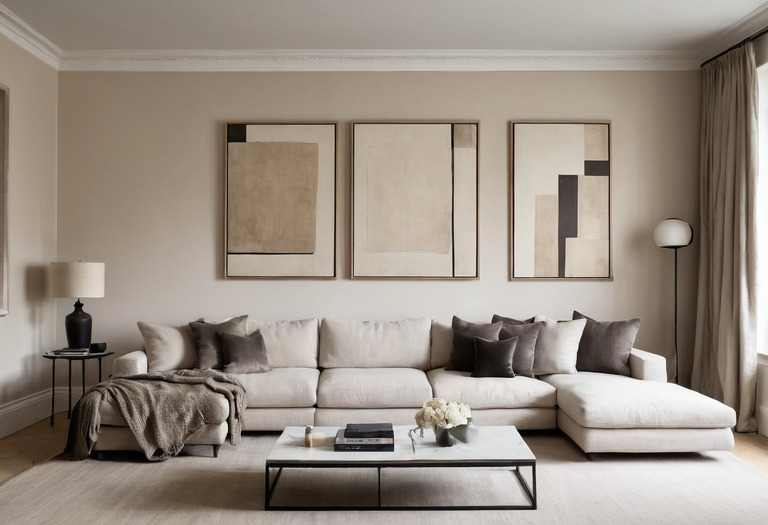
Start with the relationship between the artwork, furniture and normal viewing position. Confirm the light exposure and wall construction before anyone drills a hole.
A picture can be perfectly centered on a wall and still look misplaced. Furniture changes the visual center, glass creates reflections, daylight adds irreversible exposure, and a wall that appears solid may contain only a thin plasterboard sheet.
The reliable sequence is to measure the composition, mock up the frame, check the light, identify the substrate and only then set the fixing points. The same discipline used for cabinetry drawings and tolerances prevents most hanging errors.
What height should artwork occupy on a bare wall or above furniture?
A centerline 145-150 cm above the finished floor gives a practical starting datum for artwork viewed by standing adults. The measurement is a gallery convention rather than an ergonomic standard. Artwork above a sofa, bed or console usually needs a lower center because the furniture and frame should read as one composition.
For a bare wall, mark the proposed center rather than the top of the frame. A room with mostly seated viewing, such as a living room or dining area, can support a centerline below 145 cm. A circulation space often benefits from the 145-150 cm datum because viewers approach the work standing. The entrance lighting and circulation guidance explains why protruding frames also need clearance from bags and shoulders.
Use the following calculation for a single fixing point:
Fixing height = desired artwork center + half the frame height - hanger drop
An 80 cm-high frame centered 145 cm above the floor has a top edge at 185 cm. A wire that reaches 25 cm below the frame top when loaded places the hook at 160 cm above the finished floor. Pull the wire upward while measuring because loose-wire dimensions give the wrong fixing height.
Above a sofa or console, begin with a 15-25 cm vertical gap between the furniture and the frame. The lower edge must also clear seated heads, table lamps and objects placed on the surface. Furniture width rules such as making art exactly two-thirds of a sofa have no scientific basis. A paper template gives better information than a fixed proportion.
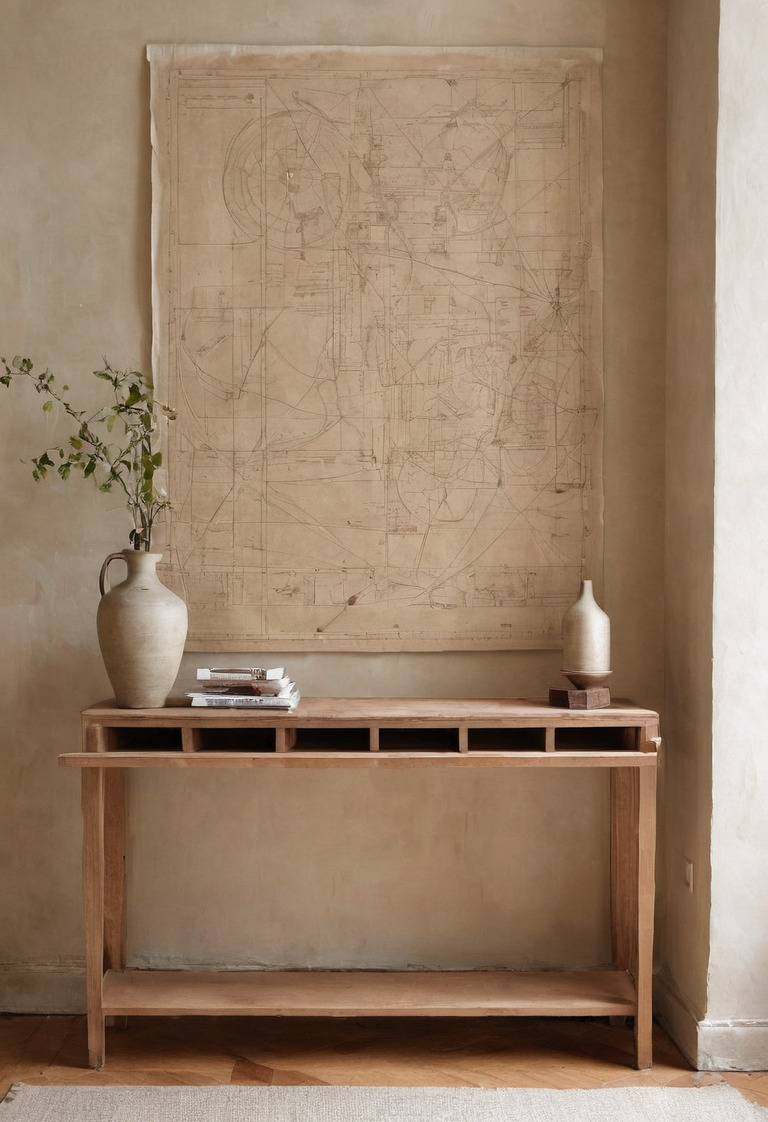
The useful datum is the artwork's visual center, not the position of the hook or the height of the nearest door frame.
Irregular works may have a visual center that differs from the measured center. A frame with a deep bottom mount, for example, can appear low even when the outer frame is mathematically centered. The principles behind visual weight in monochromatic rooms also apply to dark mounts, broad frames and high-contrast images.
How much space should sit between frames in a group?
Consistent gaps make separate frames read as a deliberate group, while varied gaps emphasize individual objects. A 5-8 cm gap suits many domestic groups containing frames 30-80 cm wide. Smaller frames can sit closer, and large works need more breathing room so that the wall remains visible between them.
| Frame condition | Suggested gap | Reason |
|---|---|---|
| Small frames under 30 cm wide | 3-5 cm | Keeps small objects from appearing scattered |
| Medium frames 30-80 cm wide | 5-8 cm | Maintains separation without breaking the group |
| Large frames over 80 cm wide | 8-12 cm | Allows each large edge to remain legible |
| Salon arrangement with mixed sizes | 4-7 cm recurring gap | Creates rhythm across otherwise unrelated dimensions |
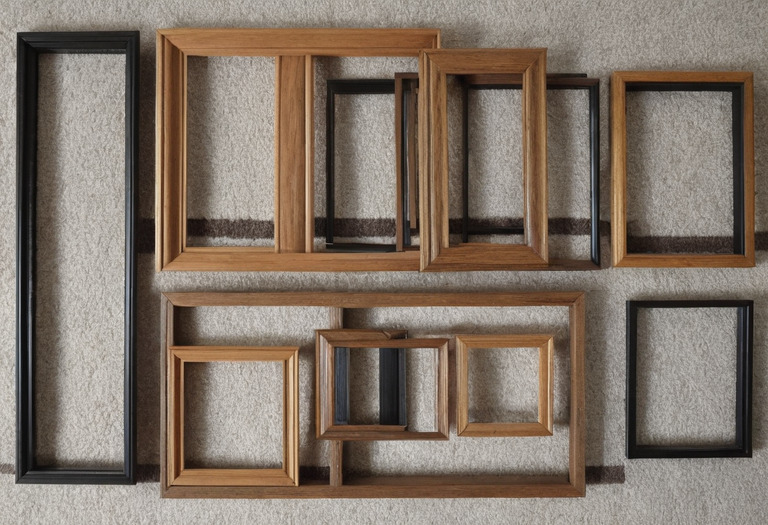
Lay a complex arrangement on the floor or reproduce every outer frame dimension with paper. Establish one governing line, such as a common centerline, top edge or vertical axis. A group based on several unrelated alignments often looks accidental.
Treat the full group as one large object when positioning the composition above furniture. Measure the group's outer rectangle and center that rectangle over the furniture unless a lamp, doorway or architectural feature creates a stronger reason for asymmetry. Minimal rooms with controlled tolerances need especially precise gaps because fewer surrounding objects are available to disguise small errors.
Two hooks generally keep a wired frame more stable than one hook. The two fixing points also resist gradual tilting caused by cleaning, vibration or an uneven frame. Measure both points with a level rather than relying on the ceiling, cornice or floor, since surrounding construction may not be level.
How should artwork be lit without glare or avoidable fading?
Aim an adjustable ceiling light at roughly 30 degrees from the vertical wall plane as an initial glare-control position. Measure illuminance at the artwork rather than beneath the fitting. Light-sensitive works on paper are commonly displayed at no more than 50 lux, with exposure time limited because cumulative dose drives fading.
A 30-degree aiming angle provides a calculable starting position. Where an artwork center is 1.50 m above the floor and a ceiling light is 2.70 m above the floor, the vertical difference is 1.20 m. A light ray set 30 degrees from vertical places the fitting about 0.69 m horizontally away from the artwork centerline. Ceiling obstructions and frame glass can still require adjustment.
Reflections depend on the angle between the light, glazing and viewer. Test the beam from the actual sofa, dining chair or standing position. Museum-grade anti-reflective glazing can reduce visible reflections, but no glazing removes every reflection at every viewing angle.
For paper, watercolors, many photographs and dyed textiles, 50 lux at the object is a common conservation limit. A display receiving 50 lux for 5 hours each day accumulates 91,250 lux-hours during a 365-day year. Dimming and shorter operating hours directly reduce that annual dose. Sensitive pigments can still fade under visible light even where glazing filters ultraviolet radiation.
Oil and acrylic paintings are often allowed more light than paper, but pigment, binder, varnish and prior condition change the acceptable exposure. A conservator should assess valuable or demonstrably light-sensitive work. Decorative preference cannot predict material stability.
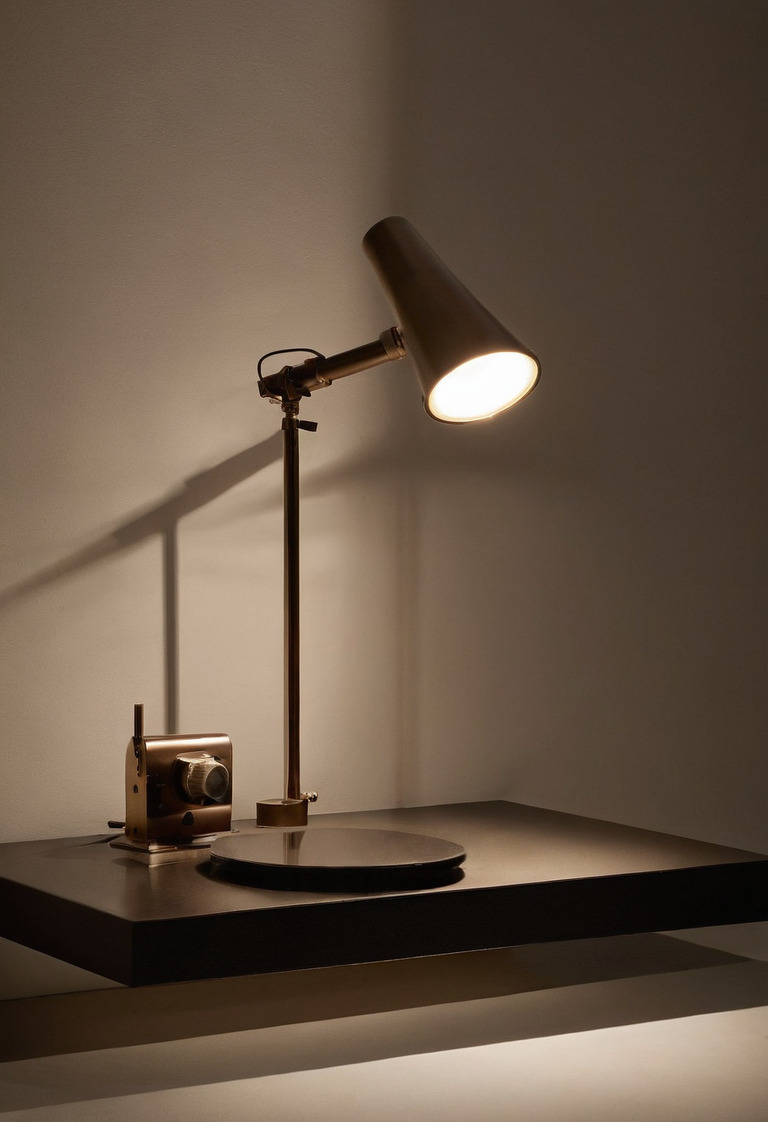
A handheld lux meter provides a more useful reading than a phone camera. Measure on the artwork plane with daylight and electric light assessed separately. The three-layer lighting method helps keep accent light in proportion to ambient light, while the guide to feature lighting and glare addresses exposed lamps and bright reflections.
Daylight exposure continues when the artwork light is off. Curtains, blinds and glazing should be considered alongside artificial lighting. The guidance on daylight, fabric openness and fading explains why ultraviolet film alone cannot protect sensitive colorants.
A picture light attached to the frame can provide even local illumination, but the fitting must not warm the artwork or place bright points in reflected glass. Use a dimmable source with good color rendering and check the manufacturer's photometric data rather than judging the fitting by wattage.
Which fixing belongs in plasterboard, masonry or a hollow wall?
The correct fixing depends on wall construction, board thickness, cavity depth, frame weight and load direction. Plasterboard plugs, cavity toggles and masonry anchors are not interchangeable. A heavy or valuable work should connect to a structural stud, installed backing or fixing with a published capacity for the actual substrate.
Plasterboard and drywall
A screw into a timber stud provides a direct structural connection. Stud position must be confirmed because tapping the wall or trusting a detector alone can misidentify pipes, cables or resilient channels. Metal studs require a fixing strategy suited to the stud gauge and wall build-up.
Cavity toggles spread load behind the board and can support frames where no stud is available. The selected toggle must match the plasterboard thickness, cavity depth and manufacturer's tested loading condition. Self-drilling plasterboard anchors suit modest loads, but capacity varies sharply with board condition and installation quality.
Brick, block and concrete
Solid brick and concrete generally require a drilled hole, a compatible plug or anchor, and a screw diameter suited to the frame load. Hollow block needs an anchor designed to expand or bond within a void. Weak mortar, crumbly masonry and old plaster finishes should not be treated as sound structural material.
A contractor should scan for concealed services before drilling. Service zones and construction practices differ between countries, so a remembered rule about cable positions is not enough. Renovations that need future picture locations can include plywood backing before the wall closes, much like the advance decisions described in smart-home renovation planning.

- Single light frame
- Use one or two picture hooks only where the hook is rated for the identified wall build-up and actual loaded frame weight.
- Wide frame
- Use two level fixing points or a continuous cleat to distribute load and resist rotation.
- Heavy or valuable work
- Prefer studs, installed backing, structural masonry or an engineered hanging rail with documented fixings.
- Unknown wall
- Open a discreet inspection point or ask the contractor for construction records before drilling.
Fixing capacity is only part of the check. D-rings, wire, frame corners and cleats must also carry the load. Framing wire should be tensioned without pulling the side rails inward, and screw eyes should seat in sound frame material rather than a thin decorative edge.
What should be checked before the final holes are drilled?
A full-size paper template should remain on the wall for at least one daylight and evening viewing cycle. The final check should cover eye level, furniture clearance, reflections, door swings, wall services and frame hardware. Paint sheen also deserves attention because glossy walls can produce a second field of glare around glazed art.
Photograph the template straight-on and from the main seat. Camera images often reveal a drifting centerline or cramped edge that becomes familiar during installation. Review the wall under the scenes described in the room lighting plan, not only under full ceiling light.
Flat or low-sheen paint usually produces fewer distracting reflections than a glossier finish, although cleanability and substrate quality still matter. The comparison of paint sheen and washability helps resolve that tradeoff.
Record the finished fixing positions, wall construction and artwork weight for future rehanging. Careful records reduce exploratory drilling and allow the next owner, installer or designer to understand why each fixing was chosen.
Questions readers ask
- What is the standard height for hanging art?
- No universal standard controls domestic art height. A centerline 145-150 cm above the finished floor is a useful starting point for artwork viewed while standing, but furniture and seated viewing can justify a lower position.
- How far above a sofa should a picture hang?
- A gap of 15-25 cm between the sofa back and the bottom of the frame usually keeps both elements visually connected. Deep sofas, low ceilings and the height of seated occupants can require a larger clearance.
- How many lux are safe for works on paper?
- Conservators commonly limit light-sensitive paper, photographs and textiles to 50 lux at the object. Exposure duration matters because fading is related to accumulated light dose, not brightness alone.
- Can a heavy picture hang directly from plasterboard?
- A heavy picture should use a timber stud, installed backing or a cavity fixing rated for the actual plasterboard thickness and frame load. A generic plastic plug has no dependable capacity in an unsupported plasterboard cavity.